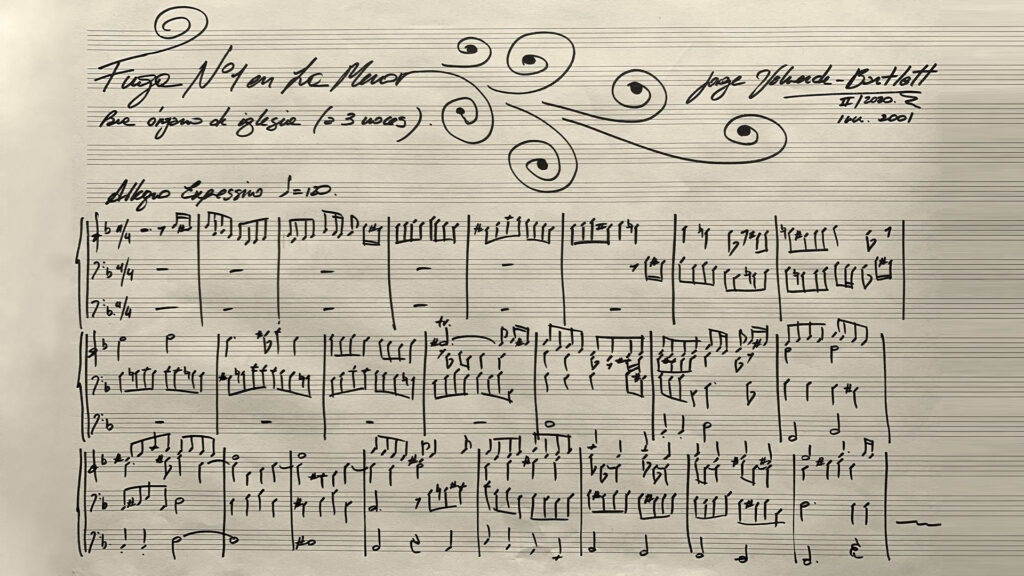
To engage with the fugue is to engage with one of the most intellectually profound and spiritually resonant forms in all of Western music. It is a tradition perfected and defined by the organ works of Bach, a towering legacy that few contemporary composers dare to approach. With his Fugue No. 1 in D minor, Jorge Valverde not only approaches this tradition but proves himself a worthy successor, crafting a work of immense power, structural integrity, and deep emotional gravity.
The work is constructed with a master’s hand, leading the listener on an inexorable journey from a statement of profound sorrow to a conclusion of breathtaking, triumphant light.
The Exposition
The fugue opens with an exceptionally clear presentation of its subject by a single voice in the manuals, showcasing a theme that stands as a model of concise expression. Structured in the noble yet tragic key of D minor, it features a stately, dotted rhythm alongside a striking melodic outline—one that pairs a resolute upward leap with a poignant, chromatic descent to convey both deep pathos and inherent strength.
Following tradition, a second voice introduces the Answer by rendering the theme in the dominant key of A minor. Simultaneously, the initial voice provides the First Countersubject, which is a fluid, interwoven line composed of faster notes that maintains a steady rhythmic drive and serves as an ideal contrapuntal complement to the primary theme. As the third and faux-fourth voices make their subsequent entrances to take up the subject, a Second Countersubject unfolds, fully establishing an intricate web of harmony and melody.
This exposition reaches its dramatic peak with the authoritative arrival of the pedal division. Stating the subject in its full grandeur within the lowest register of the organ, it delivers a powerful, rock-solid foundation that will underpin the remainder of this magnificent musical architecture.
The Development
Valverde demonstrates his complete command of contrapuntal technique as the fugue enters its development section, with all voices now fully engaged. Through a series of intricate Episodes, fragments of the subject and countersubjects are passed in an elegant and complex dialogue between the manuals and the pedals. This masterfully guided harmonic journey modulates through related keys, offering a brief, plaintive sojourn into the relative major (F Major) as a fleeting moment of solace amidst the prevailing minor-key intensity.
As the development progresses, the tension builds through the dramatic device of Stretto, where the subject entries begin to overlap and pile on top of one another with increasing urgency and complexity. This drives the fugue towards its inevitable climax, creating a powerful sense of intellectual and emotional intensification.
Climax and Coda
Representing a true pinnacle of form and sonority, the concluding section pushes relentlessly toward the tonic key of D minor. Driven by an intense dominant pedal point that heightens anticipation to an extraordinary degree, the tension finally breaks. Valverde commands the organ's full, resonant power to deliver a magnificent, final iteration of the subject.
This musical odyssey through the dense shadows of D minor culminates in an extraordinarily moving resolution. Rather than settling into the anticipated minor mode, the final chord shifts dramatically into a radiant D Major. This utilization of the Picardy Third acts as a spectacular burst of illumination, offering a transcendent sense of peace and triumph that completely reframes the composition's preceding melancholy.
Commentaries by Joseph Arwin, Music Critic and Coinnoseur at Tunecore, Inc.